
Why Georgia Red Clay Matters for Your Roswell Concrete Project
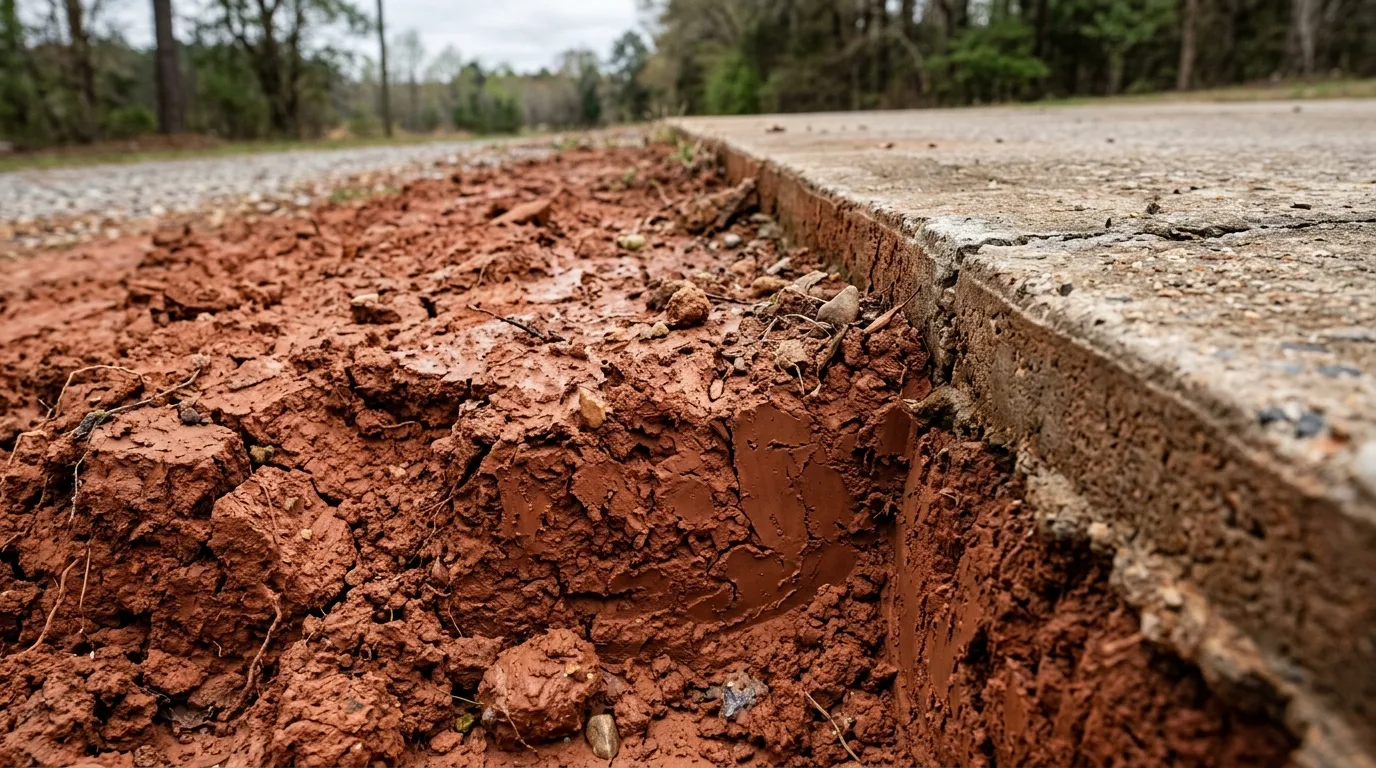
Most concrete problems in Roswell, GA trace back to the same source: Georgia red clay. Roswell sits on the Piedmont region’s characteristic expansive clay soil — a material with a high plasticity index that behaves very differently from the sandy soils found in coastal Georgia or the sandy loams of north Georgia’s mountain foothills. Understanding how this soil behaves helps Roswell homeowners ask the right questions before hiring a contractor and understand why the cheapest bid often costs the most over time.
Concrete Built for Georgia Red Clay
We spec every Roswell project for local soil conditions. Call (888) 376-0955 for a free estimate.
What Makes Georgia Red Clay Different
Georgia red clay is characterized by a high percentage of expansive clay minerals — primarily kaolinite and smectite — that absorb water molecules into their crystal structure and expand volumetrically. The plasticity index (PI) of Roswell-area soils typically ranges from 25–40, which engineers classify as “medium to high” expansive potential. For comparison, beach sand has a PI near zero; it doesn’t expand at all.
In practice, this means the soil beneath a Roswell driveway or patio expands measurably when saturated and contracts measurably when dry. The differential between wet and dry states can be significant enough to cause visible surface displacement. Neighborhoods throughout Fulton County — from East Roswell near GA-400 to the established communities off Woodstock Road — sit on this same clay formation, and any concrete installation that doesn’t account for its behavior will show problems within 5–15 years.
How Clay Soil Damages Concrete in Roswell
Slab heaving occurs when clay beneath a slab absorbs moisture and expands upward, lifting the concrete. In Roswell, this happens most visibly after heavy spring rains when the clay reaches peak moisture content. Heaving concentrates at the weakest points in the slab — control joints, edges, and mid-slab seams — creating raised sections that present as trip hazards and cracking at the heaved edges.
Settlement and void formation occurs as the clay dries and contracts during Georgia’s drier summer months. The soil pulls away from the underside of the slab, creating voids. When a vehicle or heavy load crosses a section with a void beneath it, the unsupported slab flexes and cracks. This is the origin of most random mid-slab cracking in Roswell driveways that aren’t at control joints.
Foundation wall pressure is the most serious consequence for structural concrete. When saturated clay expands against a basement or crawlspace wall, it exerts hydrostatic and expansive pressure that exceeds the design capacity of foundation walls not engineered for these loads. This is the cause of horizontal foundation cracking in Roswell’s older homes — walls built before modern understanding of local soil behavior made it into standard construction practice.
Edge deterioration affects unprotected slab edges. Clay that alternately saturates and dries immediately adjacent to a slab edge creates repetitive stress on the concrete’s most vulnerable point — the unsupported cantilever at the edge. Driveways with no gravel shoulder or adjacent landscaping that directs water against the slab edge show accelerated edge cracking.
Concrete That Accounts for Roswell's Soil
Proper base prep, rebar, and drainage — not just a good-looking pour. Call (888) 376-0955.
What Good Contractors Do Differently for Georgia Clay
4–6 inch compacted gravel base: This is the most important clay mitigation measure. A properly compacted crushed gravel layer absorbs the clay expansion-contraction movement before it reaches the slab. Contractors who install 2 inches of gravel (or none) are transferring all clay movement directly into the concrete. We compact 4–6 inches of crushed stone in lifts using a plate compactor — this is verifiable in a pre-pour inspection and should be specified in the written estimate.
Geotextile fabric above clay: A non-woven geotextile fabric between the native clay and the gravel base prevents clay migration into the gravel over time. Without it, clay particles work upward through the gravel in wet-dry cycles, gradually reducing the gravel layer’s drainage and buffering capacity.
Rebar reinforcement (not wire mesh): Wire mesh provides minimal tensile reinforcement and is ineffective in clay soil that generates significant differential movement. Rebar on 18-inch centers (or closer for structural applications) provides the tensile continuity that keeps a slab from separating when clay movement creates differential stress. Every Roswell driveway, patio, and structural slab we pour is rebar-reinforced.
Control joints at planned locations: Control joints are intentional weakened planes that direct cracking where it’s acceptable rather than where it’s random. Spacing every 8–10 feet in driveways (roughly 1.5× the slab thickness in feet = joint spacing in feet) keeps random cracking at joints rather than across the slab face. Joints that are too widely spaced allow random cracking; joints in the right locations make maintenance predictable.
Drainage design: Clay around a slab must be able to drain. Water that saturates the clay adjacent to or beneath a slab and can’t drain extends the wet cycle and the expansion period. We evaluate drainage at every site and include drainage corrections — channel drains, grade adjustments, downspout extensions — in the project scope when needed.
Practical Uses: How Clay Affects Different Concrete Types
- Driveways in Martin’s Landing: Clay expansion beneath the driveway apron (the section most affected by downspout discharge from the garage) is the most common failure point. We extend downspouts away from the driveway and install a channel drain at the base of the slope.
- Patios in Willow Springs: Clay beneath patio slabs near the home’s foundation benefits from inspection of gutter discharge — a downspout that discharges at the corner of the proposed patio area is a drainage problem that needs solving before the patio is poured.
- Foundation slabs in East Roswell: 1980s homes with original perimeter drain tile systems often have failing drainage around the foundation slab. We assess drain condition and include French drain rehabilitation when the slab shows evidence of moisture intrusion.
- Retaining walls on Horseshoe Bend sloped lots: Clay retained behind walls with inadequate drainage builds hydrostatic pressure that displaces walls. Every retaining wall we build includes drainage aggregate and perforated drain pipe behind the wall face.
- Concrete walkways near Vickery Creek Trail area: Wooded lots with root systems adjacent to walkways often compound clay issues — roots redirect drainage and create irregular soil moisture zones. We assess root proximity and factor this into joint placement.
Frequently Asked Questions
Can I tell from looking at the soil whether I have expansive clay?
The visual indicator is the characteristic red-orange color of Georgia Piedmont clay, but visual identification doesn’t tell you the soil’s plasticity index. A reliable indicator is soil behavior: does the ground crack visibly when dry (shrinkage cracks in the soil surface)? Does it become slick and sticky when wet? Both indicate high clay content. For construction projects, we probe the sub-grade during site assessment to evaluate soil composition and moisture at depth.
Does Georgia red clay affect all neighborhoods in Roswell equally?
The clay formation underlies most of Roswell’s Fulton County area consistently, but site-specific drainage and topography create significant variation in how clay soil behavior affects individual properties. Lots with positive drainage away from structures fare much better than lots with drainage toward foundations or ponding in the yard. Areas near the Chattahoochee River and low-lying sections of East Roswell may have higher water tables that keep clay moisture elevated year-round. We assess every site individually.
Why do some older Roswell concrete driveways look fine while newer ones are cracking?
Older driveways that have “held up” often have survived because of site-specific drainage advantages — a particular lot slope or soil composition — rather than because they were properly built for clay. Many are showing early signs of failure that haven’t yet become dramatic. New driveways that fail quickly almost always have an installation deficiency: thin or absent gravel base, wire mesh instead of rebar, or drainage issues that weren’t corrected. We occasionally assess “failed” driveways that are only 8–10 years old and find exactly this pattern.
Concrete Done Right for Roswell's Soil
Call Roswell Concrete Contractor at (888) 376-0955 — we design every project for Georgia red clay conditions.
Related: