
Concrete Foundation Repair in Roswell, GA: When to Call a Pro
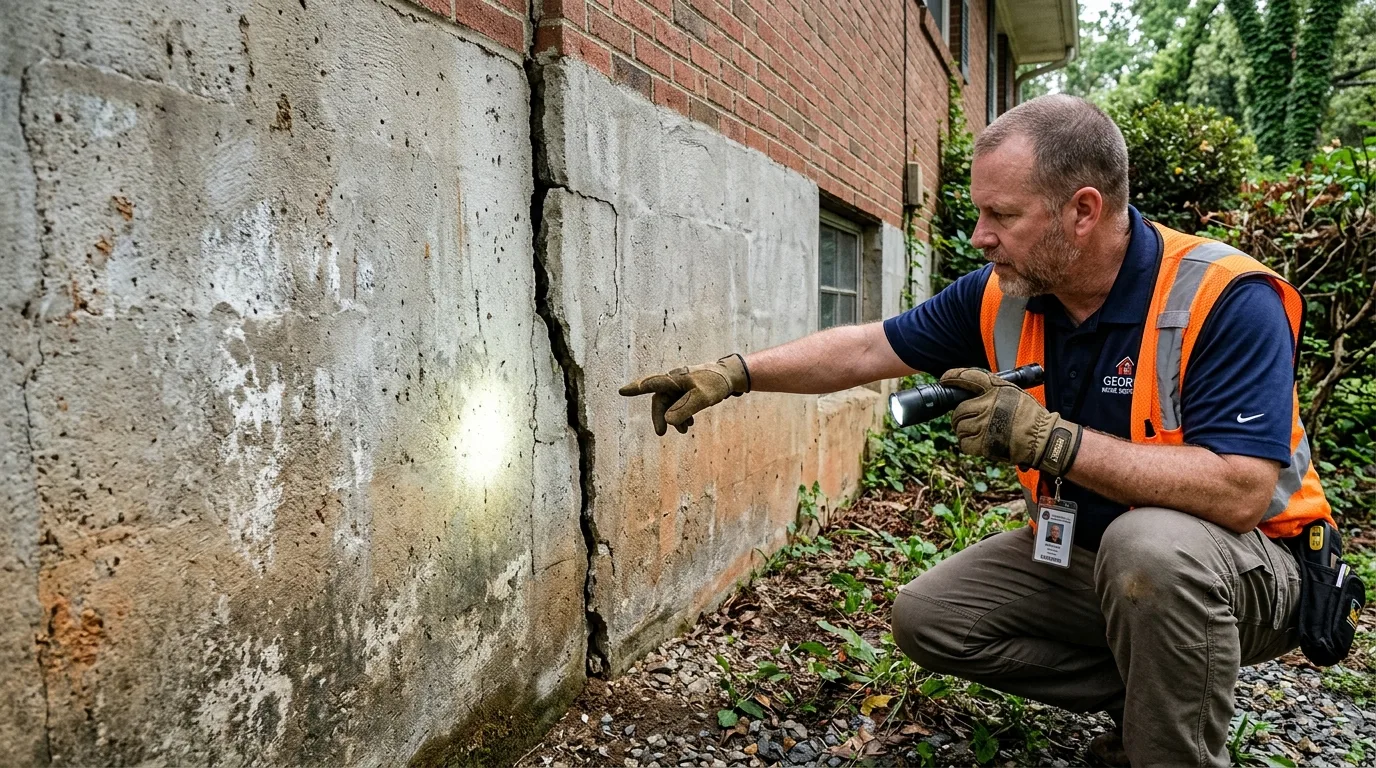
By spring, many Roswell homeowners discover foundation cracks that weren’t visible the previous fall — and they face the same question: is this serious, or is it just normal settling? The answer depends on the crack’s type, width, orientation, and whether it’s growing. In Roswell’s Georgia red clay environment, foundation cracks deserve prompt evaluation because the soil conditions that create them don’t improve on their own. This guide helps you assess what you’re seeing, understand the repair options, and know when professional evaluation is necessary.
Free Foundation Assessment in Roswell
Our team evaluates crack type, drainage conditions, and soil pressure — then gives you an honest repair recommendation. Call (888) 376-0955.
Why Roswell Homes Develop Foundation Cracks
Understanding the cause helps you evaluate the severity. Roswell sits on Georgia’s Piedmont region, where expansive red clay absorbs winter and spring moisture, expanding against foundation walls and footings. As Georgia’s dry late summer arrives, the same clay contracts — creating voids beneath slabs and pulling away from foundation walls in ways that generate tensile stress in the concrete. This cycle compounds over years.
The pattern is especially pronounced in East Roswell and Brookfield West neighborhoods built in the 1970s through 1990s, where original drainage infrastructure — downspouts, French drains, perimeter drain tile — has reached the end of its service life. When these systems fail, clay moisture becomes unmanaged, accelerating the expansion-contraction cycle and the cracking that follows. Homes near GA-400 corridors that have experienced nearby grading changes or impervious surface additions may also see increased drainage pressure on their foundations.
Types of Foundation Cracks and What They Mean
Hairline vertical cracks are the most common and least serious. Minor vertical cracks (under 1/8 inch) in a poured concrete foundation typically result from concrete’s normal curing shrinkage and don’t indicate structural movement. They should be monitored and sealed to prevent water entry, but they don’t typically require structural repair.
Wider vertical cracks (1/4 inch+) indicate differential settlement — one section of the foundation has moved relative to another. These require assessment to determine whether movement is active or historic. Mark the ends of the crack with a pencil and check again in 30 days — if the crack has grown, movement is active.
Diagonal cracks at window and door corners are the characteristic sign of differential settlement — one section of the foundation bearing more load or experiencing more soil movement than adjacent sections. These warrant professional evaluation and typically require both crack repair and drainage correction.
Horizontal cracks in basement or crawlspace walls indicate lateral soil pressure exceeding the wall’s design capacity. This is among the most serious crack types and requires prompt structural evaluation. Horizontal cracking means the wall is being pushed inward by saturated clay pressure — a condition that doesn’t resolve without structural intervention.
Stair-step cracks in block foundations follow the mortar joints in a diagonal pattern. These indicate differential settlement and require both structural repair and sub-grade drainage assessment.
Seeing New Cracks in Your Roswell Foundation?
Don't wait — early assessment costs far less than delayed structural repair. Call (888) 376-0955 for a free evaluation.
Foundation Repair Methods for Roswell Conditions
Epoxy injection is the method for structural cracks where load transfer continuity needs to be restored. Epoxy cures with tensile strength that exceeds the concrete itself, bonding the crack faces together. Appropriate for vertical and diagonal cracks that have stabilized. Epoxy is rigid — it doesn’t flex — so it’s not the right choice for cracks in walls still experiencing active movement.
Polyurethane foam injection is a flexible material that expands to fill irregular crack profiles and remains flexible after curing. It’s the right choice for waterproofing cracks where some minor ongoing movement is expected. Polyurethane doesn’t restore structural continuity but effectively prevents water entry through the crack.
Carbon fiber straps are used to stabilize bowing or leaning basement walls without excavation. Straps are bonded to the wall surface and anchored to the floor and ceiling to prevent further inward movement. This method addresses horizontal cracking and bowing walls.
Drainage correction is the most important element of lasting foundation repair in Roswell’s clay environment. Installing or rehabilitating perimeter French drains, redirecting downspouts, correcting grade, and in some cases installing interior drain tile removes the moisture that’s causing the clay to expand against the foundation. Any crack repair without drainage correction is temporary.
What Foundation Repair Costs in Roswell
In Roswell and Fulton County, foundation repair pricing ranges widely by scope:
- Single crack injection (epoxy or polyurethane): $300–$700 per crack
- Multiple cracks with drainage correction: $2,000–$8,000
- Structural repair with carbon fiber straps: $1,500–$3,000 per strap installation
- Comprehensive repair with excavation and waterproofing: $8,000–$20,000+
- Concrete slab-on-grade affected section: approximately $5.82 per square foot
Compared to neighboring Sandy Springs and Alpharetta, foundation repair pricing in Roswell reflects consistent North Atlanta market rates. The most significant cost variable is drainage scope — foundations that need only crack injection are far less expensive than those where the drainage infrastructure has failed.
Practical Uses: What You Might Be Dealing With
- New hairline crack appeared after wet winter: Monitor for 60 days, seal with polyurethane if stable, schedule drainage assessment if it’s growing.
- Diagonal crack at garage door corner, 3/16 inch wide: Schedule professional assessment — this pattern indicates differential settlement that warrants investigation of sub-grade drainage.
- Horizontal crack in basement wall, appeared in spring: Call for assessment immediately — horizontal wall cracking from clay pressure is time-sensitive.
- Stair-step block foundation cracks in 1985 Roswell home: Full assessment needed including drainage evaluation; likely requires both crack repair and drain system rehabilitation.
- Water intrusion through basement wall crack after heavy rain: Polyurethane injection plus drainage correction — the water path is the symptom; the drainage failure is the cause.
Frequently Asked Questions
How do I know if my foundation crack is structural?
The key indicators of a structural crack are: width greater than 1/4 inch, horizontal orientation, growth over time, displacement (one side of the crack is higher than the other), or occurrence at multiple locations simultaneously. Hairline vertical cracks that haven’t changed in years are generally cosmetic. The safest approach for any crack over 1/8 inch is professional evaluation — a 30-minute assessment gives you certainty that DIY monitoring doesn’t.
Can I fill a foundation crack myself?
DIY polyurethane crack injection kits are available at home improvement stores and work adequately for hairline vertical cracks that aren’t structural and don’t have active water intrusion. However, they don’t address the drainage conditions causing the crack, and they’re not appropriate for horizontal cracks, displacement cracks, or any crack wider than 1/4 inch. For anything beyond a stable hairline crack, professional assessment determines both the right repair method and the drainage correction scope. See our Georgia red clay guide for context on why drainage matters so much in Roswell’s soil environment.
How long does foundation repair last in Georgia?
Foundation repairs that correct the root cause — drainage, soil pressure, water intrusion path — last 20–30 years or more. Repairs that address only the surface crack without correcting what’s causing it may re-open within 3–5 years in Fulton County’s clay soil environment. The permanence of any foundation repair is directly proportional to how thoroughly the underlying cause was addressed.
Protect Your Roswell Home's Foundation
Early repair saves thousands. Call Roswell Concrete Contractor at (888) 376-0955 for a free foundation assessment.
Related: