
5 Signs Your Roswell Driveway Needs Replacing
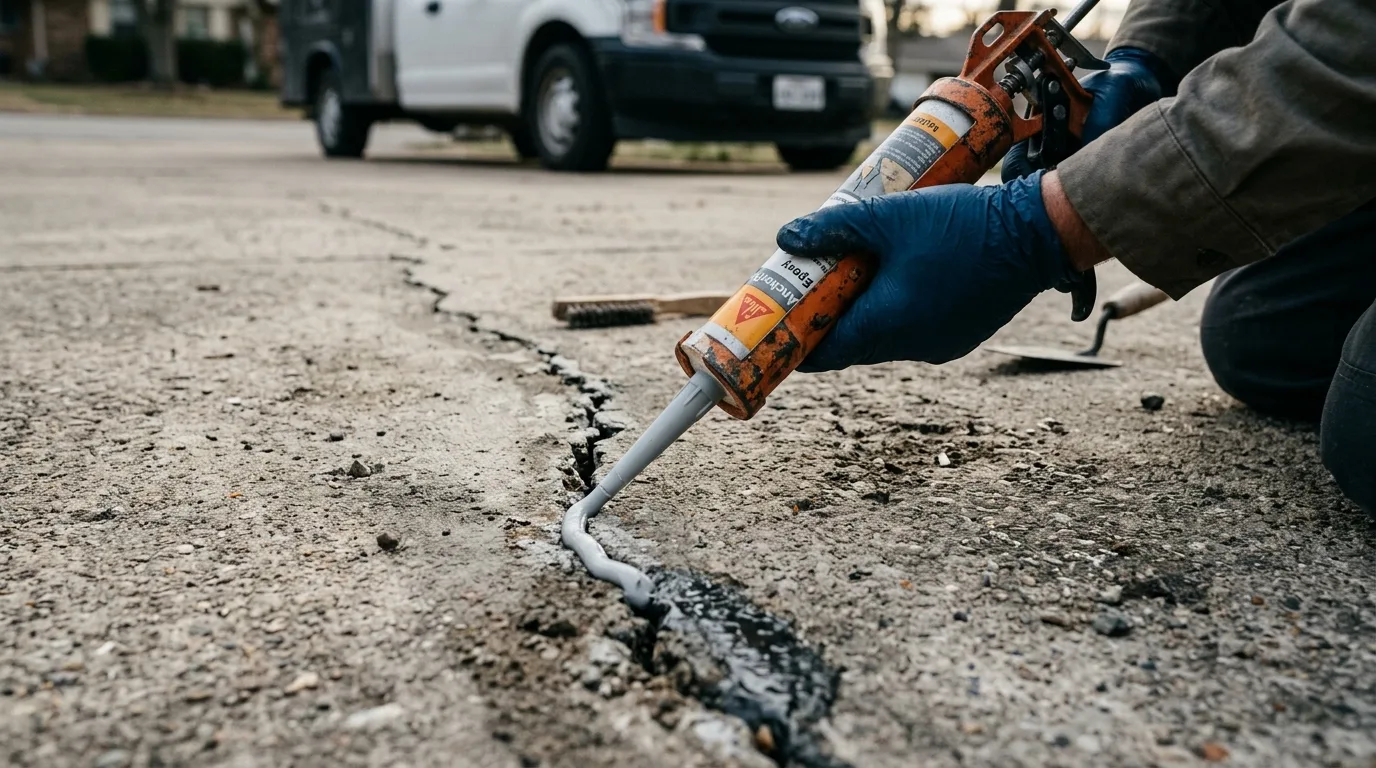
Roswell homeowners often ask us to evaluate their driveway and tell them whether repair or replacement is the right call. The answer is usually clear once you know what to look for — but there are five specific signs that consistently point toward replacement rather than repair, especially in Fulton County’s Georgia red clay soil environment where sub-base failure is the most common underlying cause of serious driveway deterioration.
Free Driveway Assessment in Roswell
We evaluate repair vs. replacement honestly — no pressure toward either option. Call (888) 376-0955.
Sign 1: Multiple Settled Sections That Keep Coming Back
The most reliable sign that replacement is the right answer is repeated settling — sections that have been mudjacked or repaired before and have settled again within 3–5 years. Mudjacking fills voids beneath a settled slab and lifts it back to grade, but it doesn’t correct the underlying cause in Georgia red clay: seasonal moisture cycling that creates new voids as the clay contracts each dry season.
If you’ve had the same section lifted twice, or if you have three or more areas that have settled on a single driveway, the sub-base has failed systemically. No repair on top of a failed base will hold long-term. Replacement with a properly compacted 4–6 inch gravel base corrects the problem rather than managing its symptoms.
Homeowners in the Martin’s Landing and Horseshoe Bend communities on clay-heavy lots often see this pattern in driveways installed before modern base-prep standards became standard practice in Roswell.
Sign 2: Widespread Cracking Through the Full Slab Depth
Surface cracking — fine cracks in the top layer that don’t penetrate the full slab thickness — can often be repaired or resurfaced effectively. Through-cracks are a different problem. When cracking runs through the full 4-inch depth of the slab, it indicates that the slab has lost structural continuity at those locations, and any resurfacing overlay applied on top will reflect those cracks through the new surface layer within 1–3 years.
The diagnostic test: look closely at the crack edge. If you can see the sub-base material beneath the crack when looking at an angle, the crack goes through. If the two sides of a crack are at different heights (called “displacement” or “offset”), the slab has moved differentially — a repair won’t restore structural continuity across a displaced crack.
When through-depth cracking covers more than 25% of the driveway surface, replacement is typically more economical than resurfacing over cracks that will reflect through within a few years.
Sign 3: The Slab Sounds Hollow and Flexes Underfoot
Walk across your driveway and tap sections with a rubber mallet or the heel of your shoe. A solid slab resting on a sound sub-base produces a solid “thunk.” A slab with voids beneath it produces a hollow, resonant sound at the voided locations. Hollow-sounding sections have lost sub-base support and will crack under vehicle load stress.
Similarly, if you notice sections of the driveway flexing or rocking slightly when driven over — a visible movement when a vehicle crosses a particular spot — that’s a slab with a void beneath it that’s currently absorbing the load through flexural stress rather than compressive bearing. Each vehicle pass creates tensile stress at the crack points around the void. This condition accelerates rapidly.
In Roswell’s climate, the hollow sound is most pronounced in late summer after the driest period of the year, when clay contraction is at its maximum and sub-base voids are largest.
Is Your Roswell Driveway Ready for Replacement?
Get a free written estimate — we spec every pour for Georgia red clay conditions. Call (888) 376-0955.
Sign 4: Drainage Problems That Redirect Water Toward the Garage or Foundation
A driveway that drains toward the structure it’s attached to has failed one of its primary functions — and in Roswell’s Georgia red clay environment, water directed toward a garage or home foundation creates both concrete and structural problems. The concrete problem: water that flows toward the garage saturates the sub-base adjacent to the foundation, accelerating clay expansion against the foundation and driveway edge, and creating a moisture cycle that accelerates cracking at the most trafficked section of the driveway.
Sometimes drainage failure results from gradual settling that has reversed the original driveway slope. Sometimes it results from poor original installation — a driveway that was never properly graded. Either way, you can’t correct this problem with repair alone. Resurfacing or crack filling doesn’t change the grade. Replacement with a new pour that establishes proper drainage slope (1/8 inch per foot away from the structure) corrects both the concrete condition and the drainage behavior simultaneously.
Near GA-400 corridors in East Roswell, we regularly see driveways where adjacent road improvements or new neighboring construction has altered drainage patterns over the years — often sending more water toward residential driveways than the original installation anticipated.
Sign 5: Age and Scale of Damage Suggest Repair Costs Will Approach Replacement Cost
If your driveway is 30+ years old and needs crack filling, mudjacking, resurfacing, and edge repair across multiple sections, total repair quotes may reach $2,000–$4,000 on a 500 sq ft driveway. A full replacement with proper base prep runs $2,500–$3,600 for the same area. The replacement price includes a new slab with 4–6 inches of compacted gravel, rebar reinforcement, control joints, and a new sealer coat — giving you a 30-year slab life instead of another 3–7 years from a multi-repair approach.
The 60% rule: when repair quotes exceed 60% of replacement cost for the same area, replacement is almost always the better 10-year decision. You’re not saving money by repairing; you’re deferring the replacement cost while spending on intermediate fixes that won’t hold as long as a properly-built new slab.
Practical Uses: Applying These Signs to Real Situations
- 2-car driveway, 28 years old, hollow in three locations, drainage flows toward garage: Signs 3, 4, and implied 5. Replace with drainage correction included in scope.
- Newer driveway (12 years) with two isolated cracks, no settling, good drainage: Neither sign 1 nor 2 applies. Crack fill and seal — repair is right.
- 500 sq ft driveway, multiple sections previously mudjacked, now settling again: Sign 1. Sub-base failed — replacement is the lower 5-year cost.
- Driveway with widespread crazing (very fine surface crack network) but no through-cracks or settling: Resurfacing with bonded overlay is appropriate — this is surface-layer deterioration, not structural failure.
- 1985 Roswell home driveway, wire mesh reinforcement (confirmed when a crack was opened), clay displacement evident: Age + sign 2 + known inadequate reinforcement = replacement with modern rebar spec.
Frequently Asked Questions
How do I know if my driveway has wire mesh or rebar?
Where through-depth cracks occur, you can often see the reinforcement material. Wire mesh appears as a grid of thin wire; rebar appears as round steel bars 3/8 to 5/8 inch in diameter. Older Roswell driveways (pre-1995) more frequently have wire mesh, which provides minimal crack resistance in clay soil. A concrete contractor can assess from visible crack sections and from probe testing at the slab edge.
What’s included in a driveway replacement estimate from Roswell Concrete Contractor?
Our replacement estimates itemize: demo and haul-away of existing slab, sub-grade excavation, gravel base installation (depth specified), geotextile fabric if required, rebar placement (spacing specified), concrete pour (mix PSI specified), finish type, control joint placement, initial sealer application, and permit fees. We don’t quote driveway replacement without a site visit — base conditions, access, and drainage scope affect the final number significantly.
How soon can I use my new concrete driveway in Roswell?
7 days for passenger vehicles; 28 days for full cure and heavy vehicle loads. We include this in the project closeout documentation and remind homeowners that while the surface feels hard within 24–48 hours, the concrete continues developing strength for 28 days. Driving on fresh concrete before 7 days risks surface marking and can cause sub-surface cracking if the concrete hasn’t reached adequate compressive strength.
New Roswell Driveway — Built Right the First Time
Rebar-reinforced, properly based, and permitted. Call Roswell Concrete Contractor at (888) 376-0955 for a free estimate.
Related: